Starfish Fungus
Aseroe rubra Labill.
Also called: Anemone Stinkhorn, Star Stinkhorn, anemone fungus, anemone stinkhorn fungus
Edibility
Edibility unknown — do not eat
Never eat a wild mushroom based on this site or any app.
Photos
-
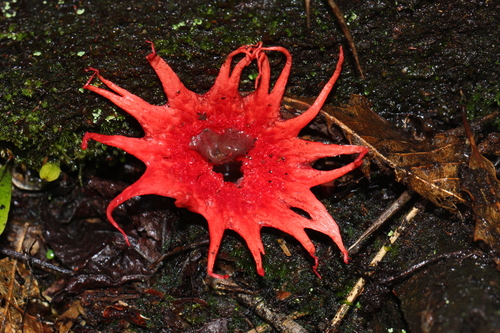
Photo: Alan Rockefeller. CC-BY. Source (inaturalist) -
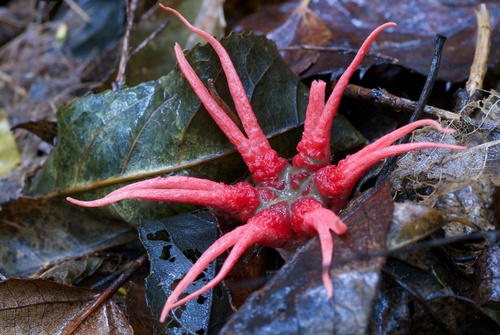
Photo: Jon Sullivan. CC-BY. Source (inaturalist)
Lookalikes
No lookalikes are recorded for this species yet. That does not mean there are none. Many mushrooms look alike, so never rely on appearance alone.
Season
When this species has been recorded, by month, from open-licensed US and Canada observations. It shows when people report it, not a guarantee it is fruiting.
The highlighted bar is the current month.
View season data as a table
| Month | Records |
|---|---|
| January | 6 |
| February | 2 |
| March | 12 |
| April | 10 |
| May | 10 |
| June | 7 |
| July | 5 |
| August | 3 |
| September | 2 |
| October | 5 |
| November | 3 |
| December | 12 |
Where it is found
States and provinces with the most records. Check the foraging rules for the place you plan to visit.
- Hawaii 51 records · Foraging rules
- Georgia 11 records · Foraging rules
- South Carolina 9 records · Foraging rules
- North Carolina 4 records · Foraging rules
- New Jersey 1 records · Foraging rules
About
Aseroe rubra, commonly known as the anemone stinkhorn, sea anemone fungus and starfish fungus, is a common and widespread basidiomycete fungus recognizable for its foul odour of carrion and its sea anemone shape when mature. Found in gardens on mulch and in grassy areas, it resembles a red star-shaped structure covered in brownish slime called gleba on a white stalk. It attracts flies, which spread its spores.
From Wikipedia, CC BY-SA 4.0. Read the original article.
Recent finds
No community finds tagged with this species yet. Log a find.
Never eat a wild mushroom based on this site or any app. See safety basics and the disclaimer.